

OUR SERVICES
The Center for Emotional Development (CED) provides a variety of services to meet the varying needs of our clients. CED offers training in the areas of Emotional Intelligence, Leadership Development, and Strategic Planning. Before the process begins, our clients are interviewed and evaluated to understand their current state and development needs. CED uses the latest tools (TESI, EQ, and EQ-360) for the assessment and development of individuals' emotional capabilities and capacities.
LEADERSHIP SERVICES
Executive and Team Coaching
Simply speaking, we help maximize the effectiveness of individuals and organizations by helping them improve their ability to lead, work together, identify and develop those with leadership abilities. To accomplish this goal we work with top management to assess and establish the appropriate management structure and staffing to meet projected client/customer needs. Once identified, we can introduce team building and individual skill development, enabling the team and individual contributors to meet those needs. The CED offers support, encouragement and structure to develop strategies for success. Coaching specialties include:
✓ Individual Coaching ✓ Group Coaching ✓ Organizational CoachingOrganizational Coaching ✓ Diversity Coaching ✓ Executive Performance Coaching
✓ Competitive Advantage Coaching ✓ Stretch Assignment Coaching ✓ Coaching High Potential Individuals ✓ Executive Derailment Turnaround ✓ Leadership Skills Development
Focus Areas:
Team Development Coaching
Enables teams to work together more effectively by improving collaboration, reducing conflict, and building high-performing teams using the TESI (Team Emotional and Social Intelligence) framework.
Transition Management
The acquisition process helps organizations manage change during mergers, acquisitions, and other major transitions. Effective transition management enables leaders to guide change, strengthen workplace culture, and support employees through organizational transformation.
Focus Areas:
✓ Managing organizational change ✓ Supporting leaders through transition ✓ Addressing cultural integration after mergers & acquisitions ✓ Improving workplace adaptability ✓ Strengthening leadership during change
✓ Understand post-merger realities ✓ Differentiate Change Management and Transition Management ✓ Prepare leaders to guide associates through transition ✓ Apply the William Bridges Transition Framework ✓ Develop an effective communication plan ✓ Align the Change Management Plan with the Transition Management Plan
Outcomes of the Training
Transition Management Process :
Burnout Management
Burnout is more than feeling blue. It is a chronic state of being out of sync at work and, if unaddressed, it can develop into a significant problem in our daily and work lives. As defined by Mind Garden, Inc., burnout is lost energy, lost enthusiasm, and lost confidence.
The key to addressing burnout is understanding oneself.
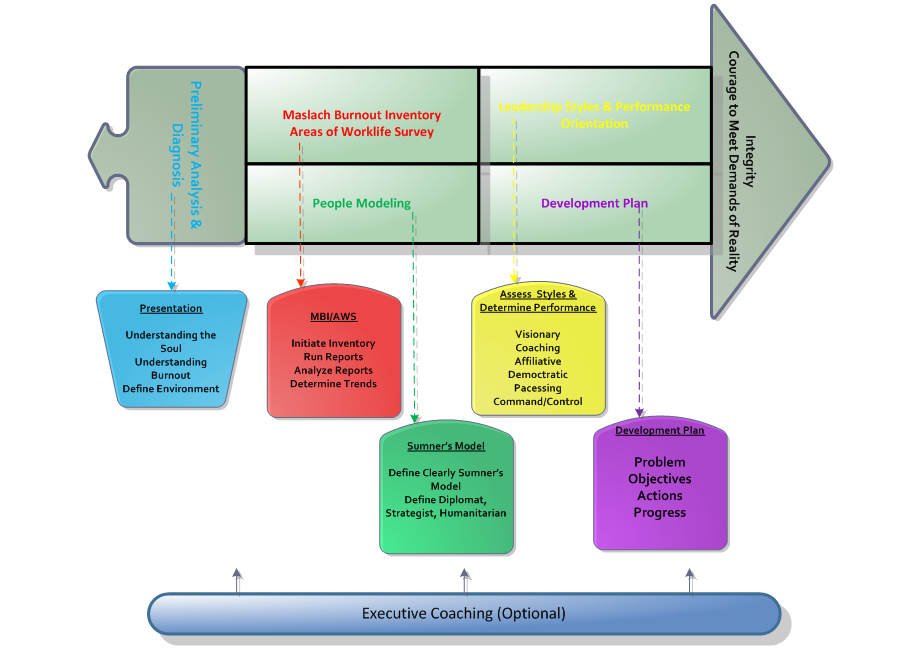
The Maslach Burnout Inventory (MBI) measures three distinct areas, while the Areas of Worklife Survey (AWS) focuses on key areas of our work lives.
Burnout Assessment
MBI : ✓ Exhaustion ✓ Cynicism ✓ Professional Efficacy
AWS : ✓ Workload ✓ Control ✓ Reward ✓ Community ✓ Fairness ✓ Values
At the End of the Training Process Participants will :
✓ Understand the burnout process ✓ Understand what burnout is ✓ Understand performance orientation ✓ Understand the symptoms of burnout ✓ Review Individual Burnout Report ✓ Review Group Burnout Report ✓ Develop Action Plans
Burnout Management Process
STRATEGIC PLANNING
Renowned Harvard Business School professor and strategist John Kotter, in his book Leading Change, cited an eight-step process for creating and exacting major change. Though the primary focus of Dr. Kotter’s book was organizational change, the steps outlined can be directed at any entity, whether an individual, corporation, or any organization. Key elements and focus of the process can be implemented. The eight steps are:
✓ Establishing a Sense of Urgency ✓ Creating a Guiding Coalition ✓ Developing a Vision and Strategy ✓ Communicating the Change Vision ✓ Empowering Broad-Based Action ✓ Generating Short-Term Wins ✓ Consolidating Gains and Producing More Change ✓ Anchoring New Approaches in Culture
Transition Management
It is important to note that while change is instantaneous, transition is emotional. Therefore, it is important to focus not just on change but on the process for achieving change, namely, transition. According to William Bridges, transition involves three steps:
✓ The End
✓ The Neutral Zone
✓ The Beginning
Strategic Planning Framework
Both Kotter's and Bridges' concepts are incorporated into the strategic plan development. The actual development of the organizational plan reflects key work by Robert B. Duncan. Duncan’s change process focuses on:
✓ The Strategic Change Cycle
✓ Organization and Culture
Program Structure
The overall program structure for engagement comprises five distinct parts:
✓ Strategic Sessions
✓ Plan Development
✓ Plan Review
✓ Goal & Plan Tracking
✓ Training on Transition (optional—separate proposal)

Emotional Intelligence, Strategic Planning, Transition Management and Burnout Management are the focus of our enterprise. Our intent is to lead organizations and their associates towards the fullness of what they are uniquely designed for, leading to optimal living for all team members.
OUR SERVICES
Leadership Services
Strategic Planning
EQ Certification
GET IN TOUCH